KNOWLEDGE TRANSFER
Karin Altmann and Sela Adjei
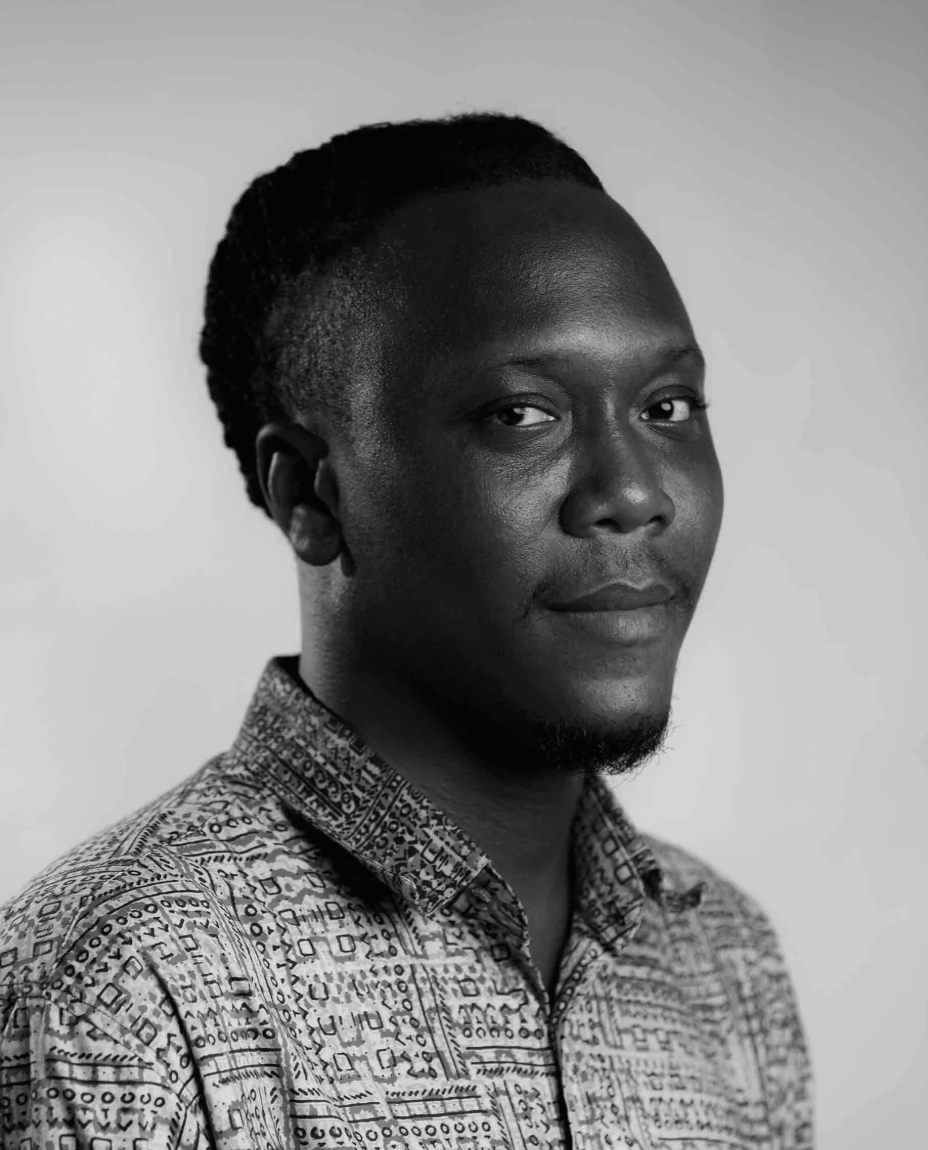
As part of the theoretical studies within the arts-based research project Spinning Stories – Living Archives, we are gathering opinions of experts from related research fields to obtain valuable contributions and inspirations for the project. Today we are interviewing Sela Adjei, a Ghanaian multidisciplinary artist, researcher and curator as part of our “reach-outs.”
K.A.: What early experiences or influences shaped your interest in digital art and indigenous knowledge systems?
S.A.: I have always been fascinated by children’s book illustrations. As a child, picture books opened a window into the world for me. Growing up, I learned a great deal from comics, storybooks, video games, cartoons, and digital media. The knowledge systems embedded in these forms of children’s literature shaped my worldview, and I soon felt a sense of responsibility toward the current generation of young readers. I believed I could contribute by creating illustrations for children’s books that preserve and celebrate African knowledge systems. That is how my journey into digital arts began. While pursuing my first degree in Communication Design at KNUST, I started freelancing as a digital illustrator for publishing houses and independent writers. This led me to explore more digital tools and applications which allowed me to pursue my passion for digital illustration.
My practice is a convergence of art, philosophy, pedagogy, and activism—rooted in a deep engagement with indigenous African knowledge systems, particularly the visual and spiritual aesthetics of Ewe Vodu. I approach my work as both an artist and a researcher, critically interrogating how African identities, spiritualities, and creative expressions have been misrepresented or misread through colonial and Eurocentric lenses. At the heart of my practice is a commitment to what I often call “theorizing from within”—a decolonial strategy that centres African epistemologies in the production and dissemination of knowledge. My artworks, writings, and teachings collectively challenge the prescriptive boundaries of modernity and its often exclusionary definitions of art and aesthetics. Through autoethnographic methods, visual ethnography, and artistic research, I attempt to dissolve the artificial binaries between ‘modern’ and ‘traditional,’ between the aesthetic and the spiritual, between the scholarly and the intuitive.
Whether I am painting, curating, teaching, or writing, my practice is guided by an ancestral logic—a sensibility that honours memory, embodiment, ritual, and resistance. It is a praxis of reclamation. My work thus reflects a deeply personal and political journey—an ongoing process of unlearning colonial education and affirming African visual and philosophical systems as valid, sovereign, and sublime.
K.A.: In what ways do you see Indigenous knowledge as living, evolving, and performative rather than static or archival?
S.A.: Indigenous knowledge, as my research consistently argues, is best understood as a comprehensive body of knowledge that constitutes a dynamic corpus of epistemologies, spiritual practices, artistic traditions and cosmologies collectively held by local knowledge holders, sages, philosopher, elders, artists and spiritual healers in African communities through sustained empirical interaction with nature, unseen forces, and their social environments. It embodies a holistic paradigm that integrates ecological stewardship, social cohesion, and a metaphysical understanding of the universe which is predominantly preserved and transmitted through art and oral tradition. Within many Ghanaian contexts—particularly in Anansesem traditions—knowledge persists through oral transmission, performative storytelling, and communal participation, which continually renew meaning and cultural awareness across generations. Oral tradition in this context, functions as a living repository precisely because it is transmitted through speech, song, performance and social interaction rather than fixed textual authority or independent inquiry.
In my work, I emphasize that what appears as continuity in Indigenous knowledge systems is often the result of creative evolution and adaptations. Ananse narratives, for example, historically evolve in response to shifting moral, social, and pedagogical needs. This flexibility demonstrates that Indigenous epistemologies are inherently evolutionary infrastructures, capable of absorbing new media yet still maintaining core cosmological concepts.
Moreover, these knowledge systems are fundamentally performative epistemologies. Their authority emerges through enactment—performative gestures, voice modulation, audience response, and embodied pedagogy. Storytelling in Ghanaian contexts is an interactive exchange that binds community through the transmission of ethics and morality.
Therefore, to treat Indigenous knowledge as merely archival risks the tendency to fossilize knowledge as a ‘static entity.’ A more appropriate framing is to view it as a living knowledge ecology that is sustained through practice, reinterpretation, and intergenerational dialogue. The critical task here is all about sustaining the conditions that allow these knowledge systems to continue evolving meaningfully across generations through art, music, design, performance, poetry and storytelling.
K.A.: What does the idea of a “living archive” mean to you?
S.A.: For me, a living archive generally exists wherever knowledge is re-enacted and socially reproduced. The archive assumes a “living” status when it is grounded in cultural philosophies and ongoing artistic practice—when photography, ethnographic film, animation, fashion, contemporary art and digital repositories emerge from African cultural heritage and indigenous knowledge.
Crucially, such an archive must operate through consultation and consent. For instance, the knowledge extracted from sacred spaces cannot be circulated without ethical deliberation and stakeholder guidance from community elders and knowledge holders. This insistence resists colonial archival logics that objectify and decontextualize African cultural heritage and knowledge systems.
In my broader artistic and curatorial practice—particularly in relation to restitution, decolonial research, and Indigenous aesthetics—I understand the living archive as a corrective to colonial archival regimes that privilege objects over communities. The archive must breathe; it must remain accountable to those whose epistemologies it holds. Thus, a living archive should move beyond merely freezing memory for posterity but rather be understood as a means of sustaining the conditions for memory to evolve, to be contested, reinterpreted, and activated in new media, including digital spaces, without severing it from its communal and ethical foundations.
K.A.: How can oral histories, rituals, storytelling, and embodied practices function as archival methods?
S.A.: Oral histories, rituals, storytelling, and embodied practices function as archival methods because, within many African epistemologies, they are the primary repositories of cultural memory. As I note in my master’s research on Akan storytelling traditions, an oral archive encompasses a memorized body of information—history, moral codes, norms, cultural values, technical knowledge, and social organization—transmitted across generations through disciplined pedagogy and performance.
Storytelling traditions such as Anansesem demonstrate that memory is preserved through repetition, adaptation, and communal participation. The story changes in retelling, yet its ethical and core philosophies persist. This elasticity ensures continuity without fossilization. Ritual practices extend this archival function, particularly within Vodu cosmology, form is inseparable from spiritual and moral function; murals, body markings, drums, and sculptural forms are consecrated presences activated through performance and sacred aesthetic traditions. The ritual itself becomes a site of record—that encodes cosmology, hierarchy, aesthetics, and metaphysics through sound and performative gestures. As demonstrated in Ewe and Akan aesthetic traditions, critical vocabularies and evaluative criteria are transmitted socially through sustained interaction with art forms.
Thus, these practices build social archives through memory, enactment, and intergenerational apprenticeship and are sustained through activation—exhibition, pedagogy and community creativity. This form of cultural sustenance presents knowledge as lived experiences rather than detached database documentation to ensure that what is remembered remains meaningful, relational, and ethically grounded.
K.A.: How can digital technologies be used to support decolonial practices rather than reproduce colonial power structures?
S.A.: Digital technologies can support decolonial practice only when they are grounded in Indigenous epistemologies and ethical accountability, rather than extractive visibility. In one of my blog essays ‘Art, Archive and the Future of Cultural Memories,’ I emphasize that digital repositories must be developed through consultation with shrines, elders, and community stakeholders, ensuring that circulation is meaningful and mutually beneficial.
Decolonial use of digital media also requires centering what I call “theorizing from within”—framing research, pedagogy, and artistic production through African philosophical systems rather than Western archival paradigms. This shifts digital practice from documentation-as-control to documentation-as-care. Crucially, not all knowledge is meant for open access. In my reflections on Vodu practice, I describe working within “zones of permission” that recognizes thresholds between what is publicly accessible and what must remain sacred and unseen. A decolonial digital strategy respects opacity, secrecy, and spiritual consequence.
Finally, digital practice must resist objectification. As I argue elsewhere, terms and systems that flatten sacred belongings into “objects” perpetuate epistemic violence. Digital platforms should therefore preserve Indigenous naming systems, contextual narratives, and cosmological frameworks in partnership with knowledge holders and cultural curators within the indigenous communities.
Used critically, digital technologies can become tools of restitution, pedagogy, and intergenerational transmission—in the process assisting communities to connect rather than acting as tools of control and manipulation.
K.A.:What tensions do you encounter when translating indigenous or embodied knowledge into digital formats?
S.A.: One key tension is that Indigenous and embodied knowledge often lives in thresholds—in gesture, atmosphere, performance, voice, sacred timing, ritual and relational accountability—while digital systems tend to flatten these into content that can be stored, circulated, and consumed.
A second tension is access versus sanctity. Digital platforms often assume that visibility equals value. But I work with what I refer to in my previous responses as “zones of permission”: there are public, pedagogical dimensions of sacred aesthetics and oral histories that can be shared, and there are zones of sanctity—esoteric knowledge, shrine-specific codes, and guarded knowledge about ritual performances—that should not be translated or exposed particularly because Vodu cosmology resists extractive knowledge regimes.
Third, translation raises the problem of interpretive frameworks. Curators, researchers, and museums—especially those unfamiliar with spiritual epistemologies—may expect explanation, legibility, and disclosure. I often respond by sharing through form without full exposition: abstraction, metaphor, or poetic strategies that evoke presence without revealing protocols; and sometimes I withhold altogether.
Finally, there is the tension of objectification and misnaming. Digital archives can reproduce Western Museum logic by reducing living cultural assets to “objects,” stripping them of agency and voice. I resist this by insisting on Indigenous names and a grammar of respect.
K.A.: How do you negotiate questions of ownership, access, and authorship when working digitally with indigenous knowledge?
S.A.: I negotiate ownership, access, and authorship through an ethics of relationship, permission, and responsibility, rather than operating through the assumption that documentation creates a sense of ‘entitlement.’ In reference to my research with Vodu visual culture, I treat knowledge as a gift earned through friendship, rapport and trust. And through these relationships that I build with my collaborators, I acknowledge that and recognize my positionality and responsibility that not all sacred knowledge systems are meant to be circulated, regardless of institutional demand.
On ownership, I resist the colonial logic that turns sacred cultural belongings into decontextualized “objects.” I prefer to name them as cultural assets or by Indigenous terms, because naming is itself a politics of agency and return.
On authorship, I do not claim proprietorship over the knowledge I carry. My position is closer to mediation: I am accountable to elders, priests, and source communities, and I let that accountability shape what gets digitised, how it is described, and who benefits.
So, rather than “capturing” Indigenous knowledge digitally, I aim to build repositories that are ethically scaffolded—community-consulted, permissioned, and oriented toward mutual benefit and cultural continuity.
K.A.: What does decolonisation mean to you beyond institutional language or theory?
S.A.: For me, decolonisation is the practical work of recovering Kwame Nkrumah’s African Genius and focusing on his insistence that African societies already hold valid intellectual, creative and moral resources for self-definition and futures-making. This requires deconnexion/delinking in Samir Amin’s sense: subordinating external dependencies to internal priorities, including cultural and epistemic sovereignty. Jose Cossa’s “metaphor of the box” clarifies the trap which implies that modernity functions like a closed box container that limits what ‘counts’ as ‘knowledge’ and possibility. In this sense, decolonisation is learning to think and act from outside that enclosure. And this is where Walter Mignolo’s epistemic disobedience becomes method—refusing the supposedly ‘universal authority’ of Eurocentric knowledge and practicing independent thought as a condition of decolonial freedom. In my own terms, it aligns with “theorizing from within,” centering African epistemologies in knowledge production. Following Quỳnh N. Phạm & Linh Tường Đỗ, decolonisation also means naming epistemic violence and using refusal, unlearning, and remaking as creative strategy. Finally, as Rolando Vázquez notes, the entire process of decolonisation demands what he terms as decolonial listening—ethical attention to those silenced by Western knowledge regimes and its ‘monopoly’ of knowledge production.
K.A.: How do you address colonial legacies within archives, museums, and digital platforms?
S.A.: The expression ‘colonial legacy’ itself is fraught with colonial logic because colonialism is not my legacy as a Ghanaian whose country was formerly colonized by the Danes, the Dutch, the German and the British. Considering all the violence, material dispossession and subjugation that came with the colonial enterprise I personally don’t share that ‘legacy’ and prefer not to associate legacy with colonialism. Ọbádélé Kambon, has eloquently argued out the negative linguistic connotations with the word legacy and its association to enslavement and colonization. You may want to refer to his paper here so readers may also unlearn and re-educate themselves: Kambon, O. Legacies and the Impact of TransAtlantic Enslavement on the Diaspora in The Journal of Pan African Studies, vol.8, no.7, October 2015.
That said, I address coloniality first by interrogating the epistemic architecture of the archive itself—its taxonomies, naming systems, and ‘claims’ to ‘neutrality’ and ‘universalism.’ Colonial archives went beyond mere collecting and cataloguing; they classified, translated, erased, misrepresented, destroyed indigenous knowledge and often misnamed. I resist what Hannah Turner refers to as ‘Dirty Data’ by restoring Indigenous terminologies and cosmological frameworks, rather than accepting Western Museum categories as default. (Refer to Turner, H. (2020). Cataloguing culture: Legacies of colonialism in museum documentation. University of British Columbia Press.)
Secondly, I centre what I call “theorizing from within”—grounding archival and curatorial work in African epistemologies rather than positioning them as ethnographic supplements to Western theory. This shifts the archive from being a site of extraction to one of epistemic sovereignty.
Thirdly, I work through consultation and stakeholder accountability, especially when building digital repositories around sacred or community-based practices. Archiving must be mutually beneficial and socially transformative, not simply preservational. Finally, I recognise “zones of permission.” Not all knowledge should be digitised or publicly accessible; some layers must remain protected. Addressing coloniality in the broadest sense needs to be methodological — which requires a general epistemic overhauling through renaming, reframing, returning authority, and designing archives that are governed by the communities whose knowledge they hold.
K.A.: How do you ensure that communities remain agents rather than subjects of archival or artistic projects?
S.A.: I ensure communities remain agents by grounding archival and artistic practice in consultation, consent, and co-creation, rather than knowledge extraction. In my research documenting Vodu visual culture, partnerships with shrines, priests, and elders were essentially guided by what was recorded, contextualized, and publicly disseminated. Access was negotiated through stakeholder dialogue and ethical considerations. Some protected knowledge systems, aesthetic traditions, and oral histories are considered pedagogical and thus shareable; while other knowledge systems remain protected. Respecting these thresholds ensures that communities determine the boundaries of visibility rather than becoming exposed subjects of study. Also proper representation and language matters and so I resist reducing cultural assets or sacred belongings to “objects,” a term loaded with the colonial museum logic. Restoring Indigenous naming systems reasserts agency and cosmological context.
Finally, I frame archives as tools for mutual benefit—supporting community development, pedagogy, exhibitions, and intergenerational transmission rather than institutional accumulation. Taking agency as a method, where members of the communities are considered as equal collaborators, knowledge-holders, and decision-makers, not raw material for artistic or academic gain.
K.A.: What does care look like in curating digital and knowledge-based works?
S.A.: Care in curating digital and knowledge-based works, for me, begins with recognising creative practice as relational labour rather than a mere isolated production. I have argued elsewhere that creative work is embedded in webs of interdependence and must be approached through an ethics and aesthetics of care. Care, first, looks like relational attentiveness: designing projects that prioritise mutual respect, trust-building, and dialogue between researchers, artists, and communities. Careful preparation determines who is invited, how themes are framed, and how space is structured. These are all effective decisions that shape power and participation.
Secondly, care manifests as co-creation rather than extraction. I rely on artistic research workshops as care-oriented methodologies where participants generate, interpret, and exhibit knowledge collaboratively. This reduces hierarchical distance and strengthens the research–practice nexus.
Thirdly, care involves aesthetic responsibility. Curating digital or knowledge-based works must attend to how meanings are evoked—to allow multiplicity rather than authoritative closure. Exhibitions and digital platforms should invite dialogue, reciprocity, and reflection rather than passive consumption. Finally, care requires acknowledging labour and constraint: time, emotional energy, and care conflicts. Care in my view is a methodological and ethical commitment to reciprocity, attentiveness, and creative equity.
K.A.: What gets lost and what can be gained when stories are recorded, digitised, or exhibited?
S.A.: When stories are recorded, digitised, or exhibited, what can be lost is often the living conditions of transmission: voice, timing, audience response, and the ethical protocols that govern who may know what. In sacred contexts, translation can in a way become exposure. Some knowledge systems remain public and pedagogical, while other layers—initiatory codes, shrine-specific meanings—should not be converted into accessible content. Digitisation can also reproduce colonial “objectification,” turning living cultural belongings into consumable artefacts and stripping them of agency and cosmological context.
Yet, there are significant gains when this work is done with care and consent. In my archival practice, I stress that digital archives can allow future researchers and communities to encounter images and records of cultural practices over long durations, enabling continuity across generations. Exhibitions and arts-based dissemination can also produce new forms of dialogue by inviting multiple readings rather than a single authoritative meaning. They also allow audiences to encounter artists directly in ways that can transform perception and generate reciprocity. In a nutshell, the stakes are ethical in the sense that digitisation and exhibition can either become instruments of extractive visibility, or—through stakeholder consultation and careful framing—platforms for intergenerational memory, pedagogy, and cultural self-determination.
K.A.: What excites you most about the future of digital art in relation to indigenous knowledge?
S.A.: What excites me most is the possibility of digital art becoming a decolonial conduit—a way to extend Indigenous knowledge without reducing it to extractable content. The mere possibility of how digital art practice can centre African epistemologies is quite exciting — particularly its capacity to unsettle the inherited binaries of modern/traditional and aesthetic/spiritual that still shape how African art is read.
I’m also excited by the archival potential of digital media when it is practiced as ethical stewardship. In my work on building digital repositories around Ghanaian cultural practices, I stress the importance of ensuring that future generations can still encounter visual records of festivals, shrine aesthetics, and artistic traditions through well-structured digital archives. At the same time, the most generative future is not “open access” as a default. It is a future of permissioned visibility—where digital art respects “zones of permission” and accepts that some knowledges must remain protected, untranslated, or shared only through abstraction, metaphor, and guarded forms.
Finally, I’m excited by how digital platforms can enable more egalitarian collaborations—between artists, scholars, and communities—so that archives and artworks become socially innovative through pedagogy, exhibitions, and community benefit rather than institutional capture.
K.A.: Within the project, we posed a provocative question: If No One Learns, Can AI Take Over? If there is no younger generation willing or able to learn hand spinning, what exactly is lost and what might still be preserved? Do you think an AI could meaningfully “take over” a textile heritage?
S.A.: If no one learns hand spinning, what is lost goes beyond a vanishing technique to destabilize the entire relational infrastructure that comprises apprenticeship, touch-based intelligence, rhythm, patience, error, and the social life constructing around textiles production. In my work on care, we frame creative practice as relational labour—knowledge is carried through interdependence and mutual regard, not just through outputs. When that relational ecology collapses, the “heritage” becomes a trace without a living pedagogy.
This distinction compels us to differentiate between heritage as lived practice and heritage as recorded information. While the former depends on embodied transmission and social continuity, the latter can survive through documentation. The critical question, then, is not whether something remains, but in what form—and under whose custodianship.
What may still be preserved are the knowledge traces of the practice—its documented processes, pattern systems, technical vocabularies, visual grammars, and historical narratives—particularly when communities develop digitally stewarded archives grounded in ethical governance and sustained intergenerational responsibility.
AI could support this preservation through indexing archives, generating instructional simulations, mapping motif lineages, or helping to keep stories searchable and teachable. But AI cannot meaningfully “take over” the heritage in the fullest sense, because textile heritage is an embodied practice carefully held in place through culturally governed access—where some knowledge is public/pedagogical and other layers remain protected and untranslatable. So, AI can assist memory and transmission, but it cannot replace the living continuum of hands, bodies, and community that makes the tradition alive.
K.A.: Where do you see the limits of AI when it comes to practices rooted in touch and tactile experience?
S.A.: The limits of AI in relation to tactile practices lie in its ability to simulate and model information without being able to inhabit the embodied, relational process of apprenticeship through which such knowledge is actually learned and sustained. Hand spinning is learned through micro-adjustments of pressure, friction, humidity, muscle memory, and rhythm—forms of tactile and “touch-based intelligence” that emerge in relation to materials and mentors. When the craft disappears, what collapses is the relational infrastructure of learning and care through which such embodied knowledge is transmitted.
AI can help preserve knowledge traces—instructions, patterns, terminologies, images, and audiovisual documentation—especially through ethically governed digital repositories. But it cannot replace the social and ethical conditions that make the practice alive: apprenticeship, community validation, and culturally governed thresholds of access. In sacred and Indigenous contexts, there are also ethical considerations that we need to acknowledge which I have already discussed in my earlier submissions. So the limit goes beyond the technical (haptics, sensorimotor nuance). There are epistemic limits on how AI fails to assume the tradition’s lived body or its ability to legitimately authorise or govern the cultural/ethical protocols that surround tactile arts.
K.A.: What question about AI and textile heritage do you think we are not asking yet, but urgently should?
S.A.: An urgent question we are not yet asking is: Who will govern the data, the models, and the value generated when AI is trained on textile heritage—and how will source communities retain sovereignty over both meaning and profit? This is the critical question we are failing to address when we get too excited over the innovative value AI presents in digitizing cultural heritage. Too often, the focus is on whether AI can replicate patterns or simulate techniques. The deeper issue is custodianship. Textile heritage is embedded in relational labour, communal authorship, and culturally governed access. If AI systems are trained on digitised motifs, weaving grammars, or oral histories without structured consent and benefit-sharing, we risk reproducing a new form of extractive coloniality.
We must also ask: Can AI be designed to respect zones of permission? Not all knowledge is meant for open circulation; some layers are sacred, esoteric, or context-bound. If AI operates on logics of maximum data absorption, it fundamentally conflicts with culturally governed thresholds of visibility.
So the pressing question is not technological capability but ethical architecture: How do we build AI infrastructures that embed community consent, restricted access, and long-term cultural stewardship into their design?
K.A.: If you could pose one question to the archive itself – past, present, or future – what would it be?
S.A.: Dear archive, in whose language do you remember, and who has the authority to decide what within you must remain visible, hidden, or returned?