Karin Altmann
“Men may work from sun to sun, but women’s work is never done.” p. 71
Elizabeth Wayland Barber places hand spinning at the very centre of early human technology and daily life, and argues that before weaving could even exist, humans had to master the art of spinning—twisting loose fibres like wool, flax, or plant materials into continuous thread. This deceptively simple act was revolutionary: strong thread enabled the creation of clothing, nets, bags, ropes, and eventually woven textiles. She calls this transformation the “String Revolution,” emphasizing that spinning was as foundational to human progress as the invention of tools.
“So powerful, in fact, is simple string in taming the world to human will and ingenuity that I suspect it to be the unseen weapon that allowed the human race to conquer the earth, that enabled us to move out into every econiche on the globe during the Upper Paleolithic. We could call it the String Revolution.” p. 45
Spinning was typically done with a drop spindle, a small, portable tool that allowed women to produce thread almost constantly—while walking, watching children, or performing other tasks. Because of this portability, spinning became deeply integrated into everyday life and overwhelmingly associated with women’s labour across cultures. Barber highlights that spinning was extraordinarily time-intensive; producing enough thread for a single garment could take hundreds of hours, making it one of the most labour-demanding activities in pre-industrial societies.
“It takes several hours to spin with a hand spindle the amount of yarn one can weave up in an hour, so women spun as they watched the children, girls spun as they watched the sheep, both spun as they trudged or rode muleback from one village to another on errands.” p. 31
Despite its importance, spinning is largely invisible in the archaeological record because fibres decay. Barber reconstructs its history through indirect evidence such as spindle whorls, impressions in clay, and references in ancient texts and imagery. She also uses experimental archaeology to demonstrate the skill required to produce even, durable thread by hand.
“We know for a fact, then, that twisted fiber string and thread were available in the Paleolithic and that by 15,000 B.C. people possessed as much skill as anyone could wish for making cordage.” p. 53
Barber ultimately argues that spinning shaped social organization, economies, and gender roles. The constant demand for thread meant that women’s labour was essential to survival and trade. Her book reveals how a quiet, repetitive craft underpinned entire civilizations and sustained human life for thousands of years.
“So why is it, if women were so enslaved by textile work for all those centuries, that the spinning jenny and power loom were invented by a man and not a woman? (…) women (…) were so busy just trying to get through what had to be done each day that they didn’t have excess time or materials to experiment with new ways of doing things.” pp. 31-32
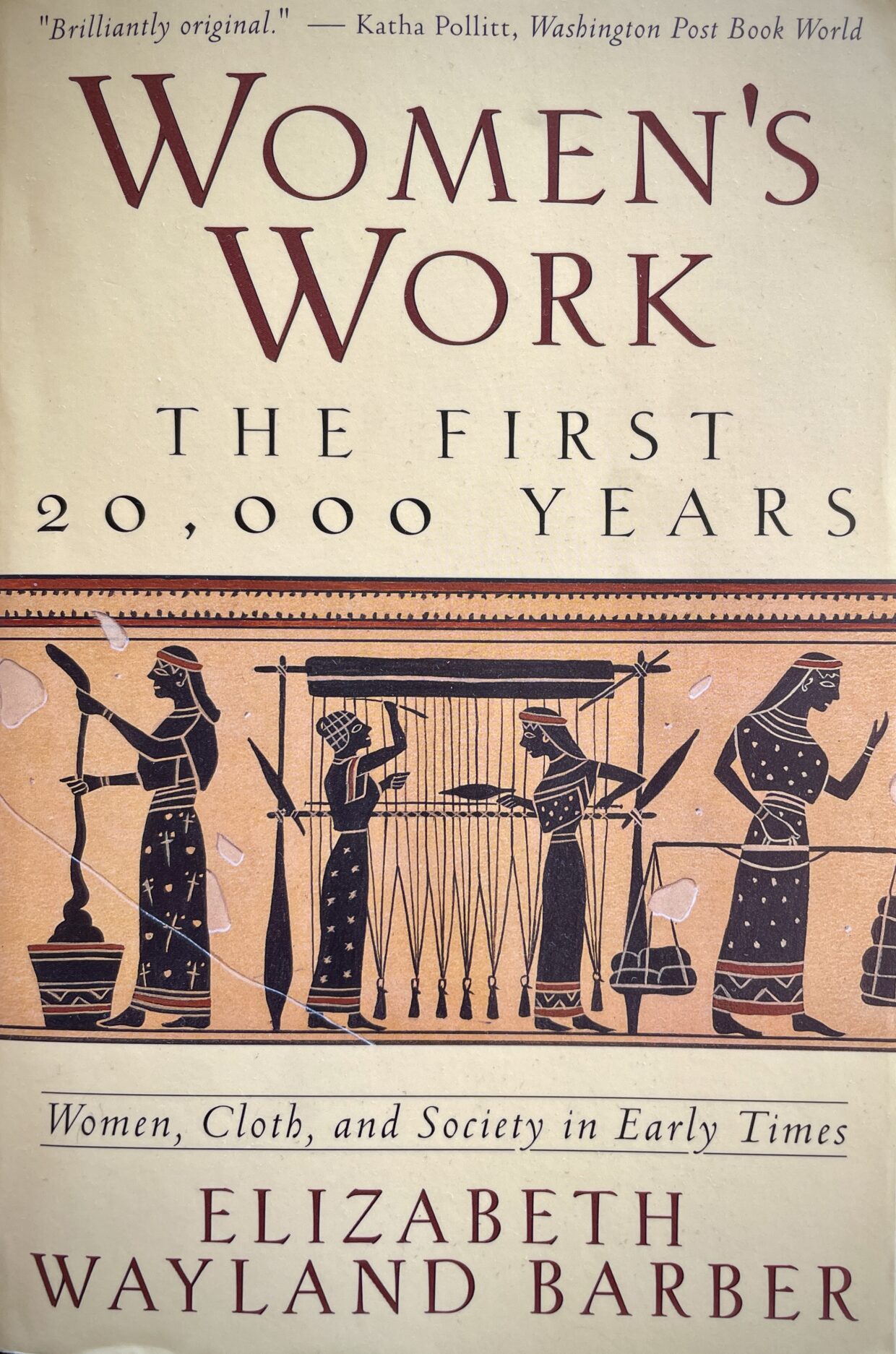
Barber, E. W. (1995). Women’s Work – The First 20,000 Years: Women, Cloth and Society in Early Times. New York: W.W. Norton.