Karin Altmann
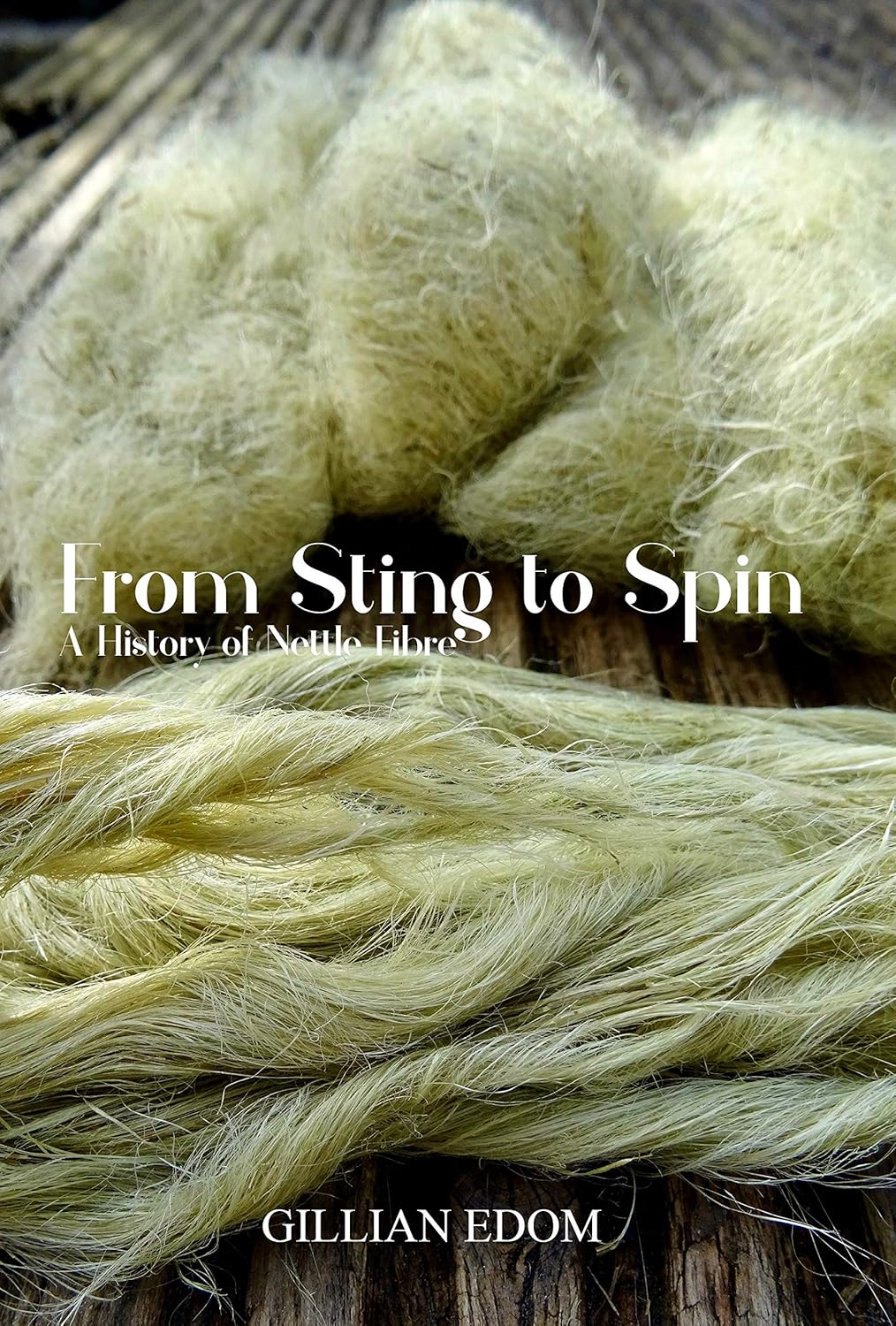
From Sting to Spin: A History of Nettle Fibre is a detailed historical exploration of how stinging nettles, particularly Urtica dioica, have been used as a source of textile fibre across time and cultures. The book brings together evidence from archaeology, ethnobotany, historical documents, fairy tales, and experimental practice to reconstruct the largely overlooked story of nettle-based textiles.
“The Stinging Nettle. A plant we love to hate and probably one of the most widely written about wild plants in the whole of Europe”. p. 2.
A central theme of the book is the long but fragmentary history of nettle fibre use, stretching from prehistoric times (around 4000 BC) to the modern era. Edom shows that nettles were once an important raw material for making thread, yarn, and cloth in various parts of the world, especially in Europe. However, the historical record is incomplete. Textile remains are rarely preserved, and even when fibres are found, it is often difficult to distinguish nettle from similar plant fibres such as flax. As a result, many claims about nettle textiles are uncertain or based on assumption rather than firm evidence.
The book also examines the cultural and literary presence of nettle cloth. References appear in myths, fairy tales, and religious stories, which have contributed to the popular idea that nettles were widely used for clothing. Edom carefully evaluates these sources, distinguishing between symbolic or fictional uses and those grounded in reality. She demonstrates that while nettle fibre was indeed used historically, its role has often been exaggerated or misunderstood due to the blending of folklore and fact.
Another important aspect is the technical challenge of processing nettles into usable fibre. Unlike more widely used fibres such as flax or cotton, nettles are difficult to process. Extracting the fine fibres from the plant’s woody stems requires skill and labour-intensive techniques. This difficulty has been a major reason why nettle textiles never became dominant on an industrial scale, despite repeated attempts, especially during times of material shortage such as the World Wars.
Edom also explores regional variations and global perspectives. While the book focuses mainly on northwest Europe, it includes references to other parts of the world where plants from the nettle family (Urticaceae) have been used for fibre. For example, she discusses practices in Asia and includes observations from Japan, where related species are still processed for textiles. This broader scope highlights that nettle fibre is not a single tradition but a collection of related practices using different species.
A recurring idea throughout the book is the gap between historical potential and practical reality. Although nettles can produce a soft, durable, cotton-like fibre, they have rarely been exploited successfully on a large scale. Edom challenges popular myths, such as the claim that Napoleon’s soldiers wore nettle uniforms, showing that such stories often lack evidence. At the same time, she emphasizes the ingenuity of individuals and small-scale craftspeople who have succeeded in producing high-quality nettle textiles.
Finally, the book looks toward the modern revival of interest in sustainable and alternative fibres. With growing awareness of environmental issues, nettle fibre has attracted renewed attention as a potentially eco-friendly textile source. Edom highlights contemporary experiments and communities that are rediscovering traditional techniques and adapting them for modern use, while pointing to the enduring appeal and future possibilities of this unusual and often underestimated material.
Edom, G. (2019). From Sting to Spin – A History of Nettle Fibre. West Sussex: Urtica Books.